





For years, “AI experience” on a resume has meant almost nothing. Anyone who has typed a prompt into ChatGPT can claim it. Hiring managers have had no reliable way to tell the difference between someone who plays with chatbots and someone who can ship a production AI system.
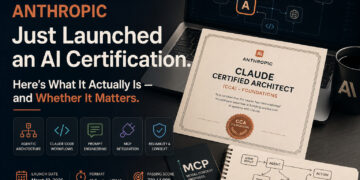
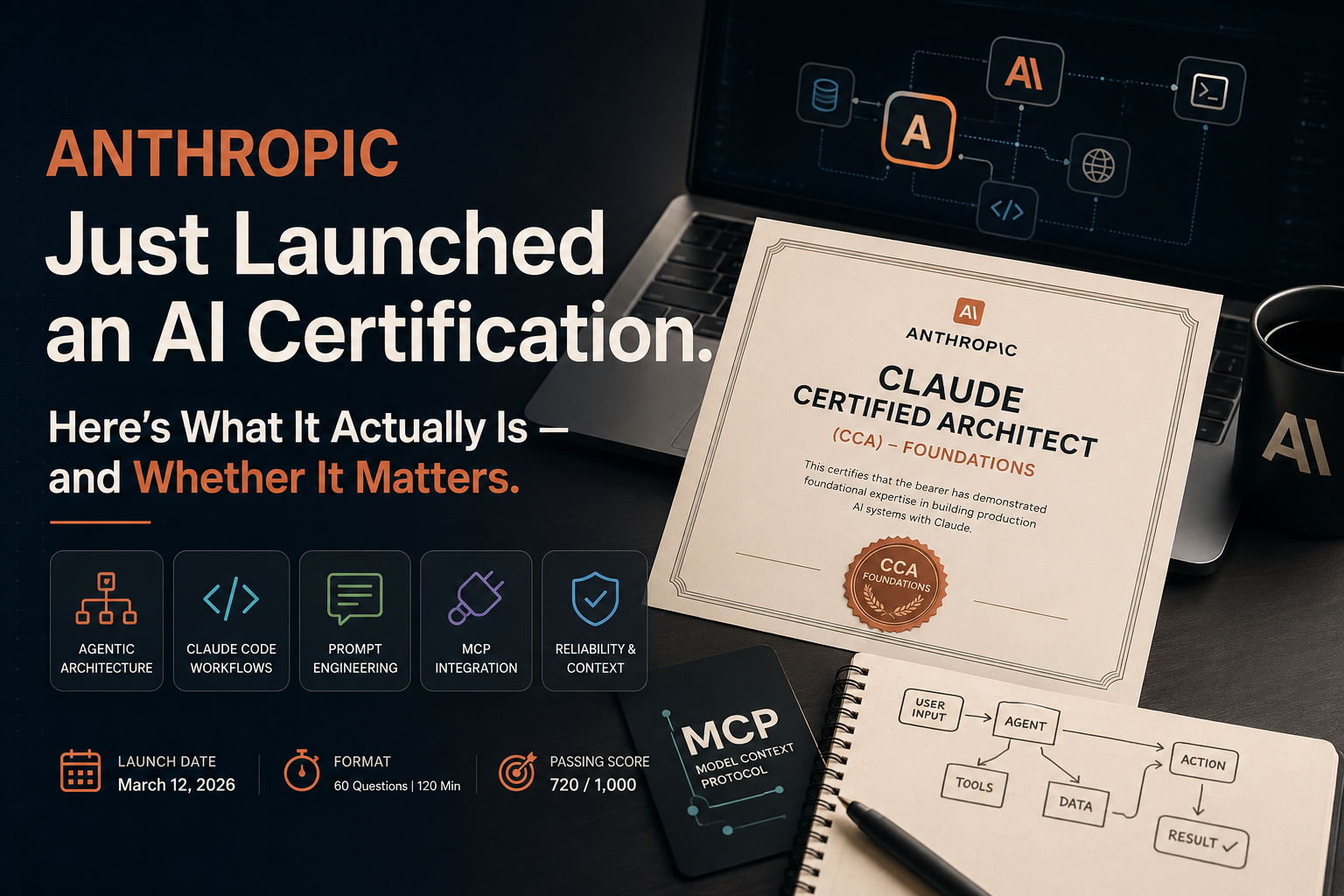
In March 2026, Anthropic — the company behind Claude — quietly took a step toward changing that. It launched its first official technical certification: the Claude Certified Architect (CCA) — Foundations exam.
If you’ve been around tech long enough, this story will feel familiar. It’s the same playbook AWS, Microsoft, and Google ran a decade ago with cloud computing — and the implications for the AI job market could be just as significant.
Let’s break it down.
What Is the Claude Certified Architect Certification?
In simple terms: it’s a proctored exam (meaning it’s monitored to prevent cheating) that tests whether you can actually build software systems using Claude — not just chat with it.
Think of it like a driver’s license for AI engineering. Anyone can sit in a car. Anyone can press buttons. But a license proves you understand the rules, the mechanics, and the responsibilities of driving on real roads.
Here are the basic facts about the exam:
| Detail | Specification |
|---|---|
| Launch date | March 12, 2026 |
| Format | 60 multiple-choice, scenario-based questions |
| Duration | 120 minutes |
| Passing score | 720 out of 1,000 |
| Cost | Free for Anthropic partner employees; $99 otherwise |
| Level | 301-level (for professionals with 6+ months of hands-on Claude experience) |
| Delivery | Online proctored or testing center |
This is explicitly not a beginner credential. Anthropic positions it for solution architects, AI engineers, and developers who already build with Claude in production environments.
What’s Actually on the Exam?
The exam is divided into five domains, each weighted by how many questions it gets:
- Agentic Architecture & Orchestration — 27%
- Claude Code Configuration & Workflows — 20%
- Prompt Engineering & Structured Output — 20%
- Tool Design & MCP Integration — 18%
- Context Management & Reliability — 15%
The weighting tells a story. Almost half the exam (45%) focuses on agentic systems and tool integration — not on prompt writing. That’s a meaningful signal about where Anthropic thinks the industry is heading.
Agentic Systems: The Biggest Slice
“Agentic” is one of the most overused words in AI right now, so let’s keep it simple.
An AI agent is a system that doesn’t just answer questions — it takes actions. It can reason about a task, break it into steps, call tools (like APIs or databases), check its own work, and complete multi-step jobs without being held by the hand.
A real-world example: instead of asking an AI “what’s wrong with this customer’s account?”, an agent could pull the customer’s record from your database, check their recent orders, look up the support ticket, decide whether to issue a refund or escalate, and draft the response — all from one instruction.
That kind of system is hard to build reliably, which is why it gets the biggest slice of the exam.
MCP: The “USB-C for AI”
Another major focus is the Model Context Protocol (MCP) — Anthropic’s open standard for connecting AI models to external tools, databases, and applications.
The easiest way to think about MCP: before USB-C, every device had a different cable. MCP aims to be the universal connector for AI — one standard way for any AI model to talk to any tool, file system, or service.
Anthropic is betting heavily on MCP, and the exam reflects that bet.
Why Now? The Bigger Picture.
The certification didn’t appear in isolation. It launched alongside two other announcements that together reveal Anthropic’s strategy:
- The Claude Partner Network — a program for consulting firms and service providers building on Claude.
- A $100 million investment — committed to training, sales enablement, and partner support.
Major consulting firms are already involved. Accenture has publicly stated it’s training 30,000 of its professionals on Claude. Other large firms, including Cognizant, Deloitte, and Infosys, are part of similar enablement efforts.
This is a familiar pattern. It’s the same sequence the major cloud providers ran:
- Build a platform.
- Create certifications.
- Train an army of consultants.
- Build a partner ecosystem.
- Become the default for enterprise deployments.
That’s not speculation — it’s documented history with AWS (which dominates enterprise cloud today) and a strategy Anthropic appears to be deliberately following.
Why This Could Actually Matter
Three reasons this is worth paying attention to, even if you have no interest in taking the exam yourself.
1. It signals that AI engineering is becoming a real profession.
We’re watching the shift from “people who use AI tools” to “people who architect AI systems.” That’s a profession with standards, governance, production patterns, and — yes — credentials.
2. Early certifications tend to carry disproportionate signaling value.
When AWS certifications launched in 2013, the people who got them early were rare enough that the credential opened doors. Once millions of people are certified, the signal weakens. We’re currently in the “few certified people” phase for Claude.
3. Consulting and enterprise hiring may adopt it as a filter.
If big consulting firms start requiring the certification for AI-related engagements — which is plausible given their investment — it could become a de facto requirement for enterprise AI consulting work, similar to how AWS certifications became table stakes for cloud roles.
The Honest Reality Check
It’s worth being clear-eyed about what a certification can and can’t do.
A certification alone won’t land you a senior AI role. Hiring at that level still depends on shipped projects, real architecture decisions, debugging scars, and business judgment. No exam tests for those.
Certifications become hiring requirements slowly. Even in cloud computing, it took years for certifications to move from “nice to have” to “expected.” The same will likely be true here.
The exam is narrow. It tests Claude’s ecosystem specifically. If your work uses OpenAI, Google, or open-source models, this credential won’t directly apply — though the concepts (agentic systems, tool integration, MCP) transfer well.
That said, the broader trend is real. Other AI providers will almost certainly launch competing certifications. The professional infrastructure around AI engineering is forming in real time.
Who Should Consider Taking It?
It’s probably worth your time if you:
- Build production AI systems professionally
- Work in AI or tech consulting
- Use Claude APIs, Claude Code, or MCP regularly
- Want an early credential while the signaling value is still high
It’s probably not worth your time if you:
- Use AI mainly as a chatbot
- Aren’t building software systems
- Expect the certification alone to change your career trajectory
- Work in an ecosystem (e.g., heavy OpenAI or Gemini stack) where Claude isn’t central
How to Prepare
Anthropic offers free training through Anthropic Academy covering the relevant material:
- Building with the Claude API
- Claude Code
- The Model Context Protocol
- Agent systems and orchestration
Practice exams and community study guides have also emerged quickly, reflecting how much interest the credential has generated in its first weeks.
A reasonable preparation timeline for someone already working with Claude is 8 to 12 weeks of focused study, depending on how much production experience you bring in.
Key Takeaways
- What launched: The Claude Certified Architect (CCA) — Foundations exam, Anthropic’s first official technical certification, released March 12, 2026.
- What it tests: Production AI engineering — agentic systems, Claude Code, MCP integration, prompt engineering, and reliability — not casual AI use.
- Why it matters: It’s part of a broader Anthropic strategy (Partner Network, $100M investment, consulting partnerships) that closely mirrors how cloud providers built their dominance.
- The honest take: Certifications don’t replace real engineering experience, but early ones carry stronger signaling value, and this one reflects a real shift toward AI engineering as a formal profession.
- Bigger picture: Expect similar certifications from OpenAI, Google, and others. The professionalization of AI engineering is underway.
Whether or not you take this specific exam, the trend it represents is hard to ignore. The casual era of “AI experience” on resumes is ending. What replaces it — credentials, portfolios, demonstrated production work — is still being defined. The people paying attention now will have the most say in shaping it.