





If your team is sending every coding task to a single top-tier AI model, there’s a good chance you’re overpaying — possibly by a lot. The fix isn’t switching to a cheaper model and crossing your fingers. It’s something smarter: using the right model for the right job.
This is the same logic any good engineering manager already uses. You don’t ask your principal architect to write the meeting notes, and you don’t hand a critical security review to the new intern. AI models work best the same way. In this post, we’ll break down a practical multi-model strategy that combines Claude, DeepSeek, and Qwen to slash costs while keeping your output quality high.
No PhD required. Let’s dig in.
First, the Simple Version
Imagine you run a busy restaurant kitchen. You have a head chef, a few line cooks, and a prep team.
- The head chef designs the menu and handles the most delicate dishes.
- The line cooks execute and double-check each other’s plates.
- The prep team chops vegetables and labels containers.
If you paid head-chef wages to everyone — including the person dicing onions — you’d go broke fast. But the food wouldn’t actually taste any better.
AI models are your kitchen staff. Some are expensive specialists. Some are fast, cheap, and great at high-volume work. A multi-model strategy simply means putting each one where it shines instead of paying premium rates for tasks that don’t need premium reasoning.
The Hidden Cost of “One Model for Everything”
A typical software workflow looks like this:
- Architecture and planning
- Writing the actual code
- Code review
- Writing tests
- Documentation
- Debugging and refactoring
Many teams pipe all of it through one premium model. It works — but the bill adds up quietly. Documentation, test stubs, and routine reviews are high-volume tasks, and they burn through expensive tokens that could cost a fraction elsewhere.
The goal isn’t “use the cheapest model.” The goal is: don’t waste your most capable (and most expensive) model on work a cheaper one handles just as well.
Meet the Three Models (and What Each Is Good At)
Here’s the lineup as of mid-2026, with approximate API pricing per million tokens. (Prices move fast — always check the official pricing pages before budgeting.)
| Model | Best at | Input / Output (per 1M tokens) | Vibe |
|---|---|---|---|
| Claude (Opus 4.8 / Sonnet 4.6) | Architecture, large-codebase reasoning, multi-file refactors, complex debugging | Opus ~$5 / $25 · Sonnet ~$3 / $15 | The senior architect |
| DeepSeek (V4 Flash / V4 Pro) | Code review, algorithms, bug detection, test generation | Flash ~$0.14 / $0.28 · Pro ~$0.44 / $0.87 | The sharp, tireless reviewer |
| Qwen (3.6 / 3.7 series) | Documentation, explanations, test scaffolding, knowledge bases | Flash ~$0.19 / $1.13 · Plus ~$0.50 / $3.00 | The fast, fluent writer |
A few things worth knowing:
- Claude still leads on deep reasoning over big, messy codebases. When a change touches dozens of interconnected files, this is where premium reasoning earns its keep.
- DeepSeek has become the price-to-performance champion for pure coding work, with very strong scores on benchmarks like SWE-bench — at roughly 1/30th the cost of premium models. It’s also open-weight (MIT license), so you can self-host if you want.
- Qwen (from Alibaba) is multimodal, ships a huge context window, and produces clean, readable prose — ideal for docs. Many Qwen models are open-weight too, so local deployment is on the table.
A Quick Word on Analogy vs. Reality
Think of the three like a hospital. Claude is the specialist surgeon you call for the complicated case. DeepSeek is the experienced attending physician who catches what others miss on rounds. Qwen is the excellent resident who writes up clear, thorough patient notes. You need all three — but you’d never pay surgeon rates for chart notes.
So… Which One Is Best for Agentic Work?
This deserves its own answer, because “writing code” and “running an autonomous agent” are not the same skill. An agent doesn’t just answer once — it plans, calls tools, reads the result, fixes its own mistakes, and keeps going across many steps. Think of it less like a calculator and more like an intern you can leave alone with a task: the question isn’t “can it write the code?” but “can it stay on track for 30 steps without getting lost?”
That long-horizon reliability is where the models genuinely separate.
The short answer
- Most capable agent → Claude. As of mid-2026, Claude Opus 4.8 leads the publicly available pack on agentic coding and “computer use” (driving a terminal, browser, or IDE), with the best step-to-step reliability and recovery when a task goes sideways. If you’re handing an agent a hard, open-ended ticket and want it to finish, this is the safest bet. (Anthropic’s research-preview frontier model tops the agentic leaderboards but isn’t generally available.)
- Best open-weight agent → DeepSeek V4 Pro. It’s the standout cost-to-quality choice for agentic loops you can run at scale — and because it’s open-weight, you can self-host it. Great when you need solid autonomy without premium API bills.
- Best for running many cheap agents → Qwen (3.6 Plus / 3.7 Max). Qwen’s newer models are built for agent-centric workloads, handle tool calls reliably across long sessions, and are cheap enough to fan out dozens of parallel sub-agents. Ideal for “swarm” architectures where lots of small, well-defined tasks run at once.
One important caveat
Agentic benchmark scores depend heavily on the harness — the scaffolding around the model (how tools are exposed, how errors are fed back, how many retries it gets) — not just the model itself. The same model can look brilliant in one agent framework and mediocre in another. So treat leaderboards as a starting point, then test on your tasks in your setup.
Rule of thumb: premium model (Claude) for the hard, autonomous “go figure it out” tasks; open-weight (DeepSeek) when you want strong autonomy at low cost; Qwen when you want to run many lightweight agents in parallel.
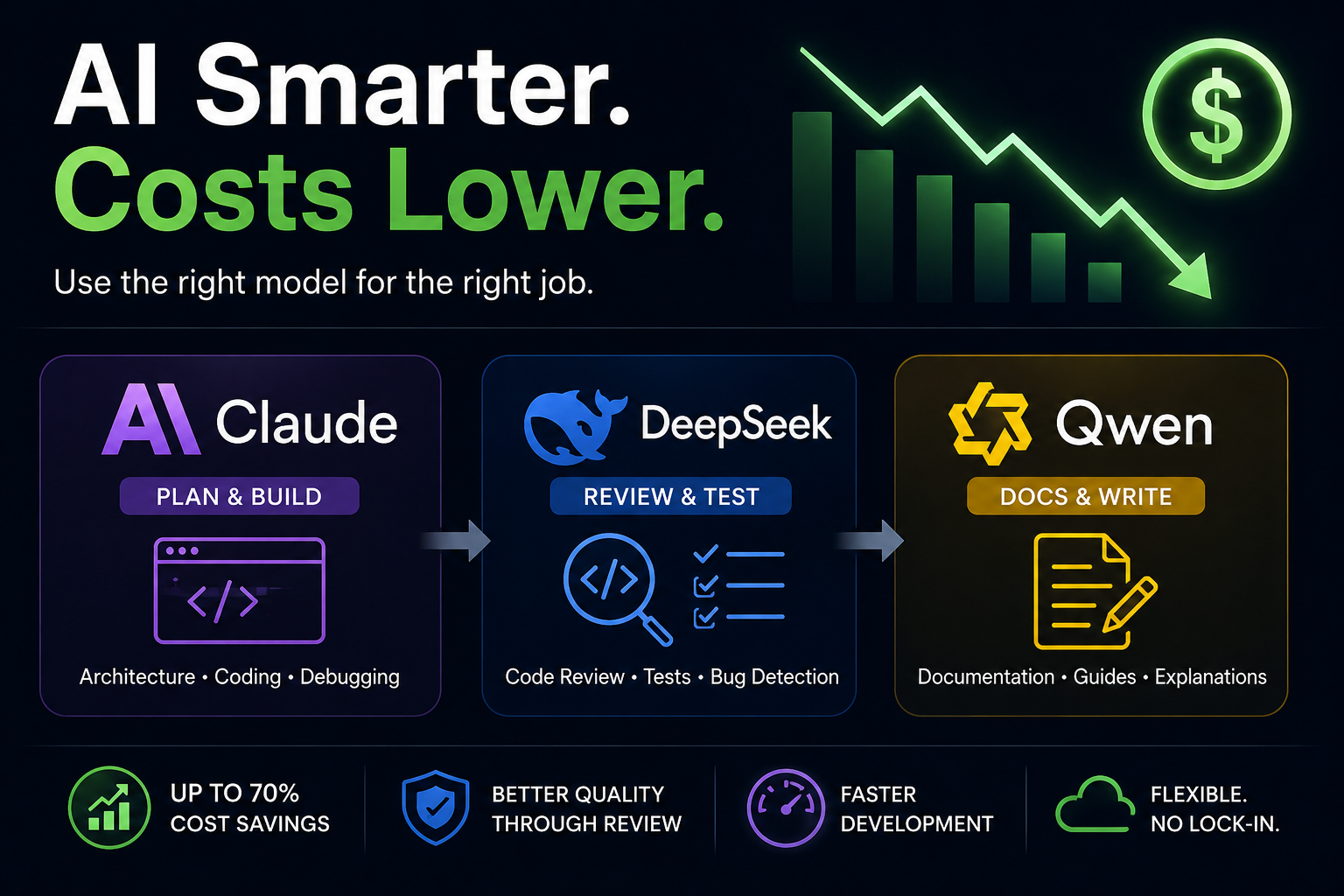
The Multi-Model Workflow in Practice
Here’s how a single feature might flow through the team:
Step 1 — Plan with Claude
Feed Claude your requirements, existing architecture, and constraints. It returns a technical design and a task breakdown. This is high-value reasoning, so premium pricing is justified.
Step 2 — Build with Claude
Use Claude (or Claude Code) for the core implementation, especially anything that spans multiple files or legacy logic.
Step 3 — Review with DeepSeek
Instead of asking Claude to grade its own homework, hand the pull request to DeepSeek:
“Review this PR for performance bottlenecks, security issues, and edge cases.”
You get an independent second opinion at a tiny fraction of the cost — mirroring how real teams have a different engineer review code before it ships.
Step 4 — Document with Qwen
Point Qwen at the finished code:
“Generate developer docs and a changelog for these REST endpoints.”
Clean, publish-ready documentation without spending premium tokens.
Step 5 — Final check with Claude
For critical releases only, bring Claude back for a final validation pass. Premium reasoning, reserved for the moments that actually matter.
What This Looks Like in Code
You don’t need anything fancy to route tasks intelligently. A simple “model router” — a function that picks a model based on task type — gets you most of the savings:
# A tiny model router: match the task to the right model
MODEL_FOR_TASK = {
    "architecture": "claude-opus-4-8",     # deep reasoning
    "implementation": "claude-sonnet-4-6", # solid coding, lower cost
    "code_review":   "deepseek-v4-pro",    # cheap, strong reviewer
    "test_gen":      "deepseek-v4-flash",  # high-volume, low cost
    "documentation": "qwen3.6-flash",      # fast, fluent writer
}

def pick_model(task_type: str) -> str:
    # Fall back to a balanced default if the task is unknown
    return MODEL_FOR_TASK.get(task_type, "claude-sonnet-4-6")

# Usage
model = pick_model("code_review")   # -> "deepseek-v4-pro"
That’s the whole idea. The complexity lives in deciding the mapping; the implementation is a dictionary lookup. Tools like OpenRouter or a thin in-house wrapper make it even easier to swap models behind one interface.
The Money: A Realistic (Illustrative) Example
Let’s say your team uses about 50 million tokens a month across all coding tasks. Here’s a back-of-the-envelope comparison. The numbers are illustrative — real costs depend on your input/output split and caching — but the shape is what matters.
| Task | Monthly tokens | All-premium (Claude Opus) | Smart-routed | Smart-routed cost |
|---|---|---|---|---|
| Architecture + core dev | 20M | Opus → ~$180 | Opus/Sonnet | ~$180 |
| Code reviews | 10M | Opus → ~$90 | DeepSeek | ~$2 |
| Documentation | 10M | Opus → ~$90 | Qwen | ~$5 |
| Test generation | 10M | Opus → ~$90 | DeepSeek | ~$2 |
| Total | 50M | ≈ $450/mo | — | ≈ $189/mo |
That’s roughly a 58% reduction — with no meaningful drop in quality, because the premium model is still doing all the work that genuinely needs premium reasoning. Across different workloads, teams commonly report savings in the 30%–70% range. Add prompt caching (up to ~90% off repeated context) and you can push it further.
It’s Not Just About Cost
Saving money is the headline, but a multi-model setup brings other wins:
- Better quality through second opinions. A reviewer model that didn’t write the code is more likely to catch its blind spots — the same reason humans don’t review their own pull requests.
- Less vendor lock-in. Spreading work across providers gives you flexibility, negotiating leverage, and a backup plan if one service has an outage or a price hike.
- More parallelism. While Claude builds the next feature, DeepSeek can review the last one and Qwen documents the one before that. Less waiting, faster shipping.
Recommended Model Allocation
A practical starting point you can adapt to your stack:
- System architecture & large refactors → Claude
- Complex, cross-file debugging → Claude
- Routine code review → DeepSeek
- Test generation → DeepSeek (or Qwen for simple cases)
- Documentation, API references, knowledge base → Qwen
- Security review → DeepSeek for the first pass, Claude for the final call
- Hard, autonomous agent tasks → Claude (highest long-horizon reliability)
- Cost-sensitive or parallel agents → DeepSeek V4 Pro, or Qwen for running a fleet
- Final release validation → Claude
Start by migrating one task type — code review and test generation are usually the cleanest places to begin. Run it in parallel with your current model for a few days, compare the outputs, and only switch once you’re satisfied. Keep an “escape hatch” that routes low-confidence results back to a premium model.
Why This Matters Right Now
Two thousand twenty-six has been a price war for AI coding models. Open-weight options from DeepSeek and Alibaba now land within a couple of points of premium models on coding benchmarks — at a tiny fraction of the price. At the same time, AI has moved from “nice-to-have autocomplete” to a core part of how software gets built. That combination means how you route work is now a real line item, not a rounding error. Teams that treat model selection as an engineering decision — not a default — will simply build more for less.
The smartest question for engineering leaders isn’t “Which model is the best?” It’s:
“Which model is best for this specific task?”
Key Takeaways
- Don’t use one model for everything. Match the model to the task, like staffing a team.
- Claude earns its premium on architecture, big refactors, and hard debugging.
- DeepSeek is the cost-effective workhorse for code review, tests, and bug-hunting.
- Qwen writes fast, clean documentation and explanations for very little — and runs cheap parallel agents well.
- For agentic work: Claude is the most reliable for hard, autonomous tasks; DeepSeek V4 Pro is the best open-weight option; remember the harness matters as much as the model.
- A simple model router (even a dictionary) captures most of the savings.
- Expect 30%–70% lower costs with similar quality — and bonus wins in quality, flexibility, and speed.
- Start small: move one task type, run it side-by-side, then expand.
Pricing and model lineups change frequently — verify current rates on each provider’s official pricing page before you budget.