





Imagine launching the most powerful product your company has ever built — and just three days later, being ordered by your own government to switch it off. Not only for users overseas, but for every non-citizen on Earth, including your own employees.
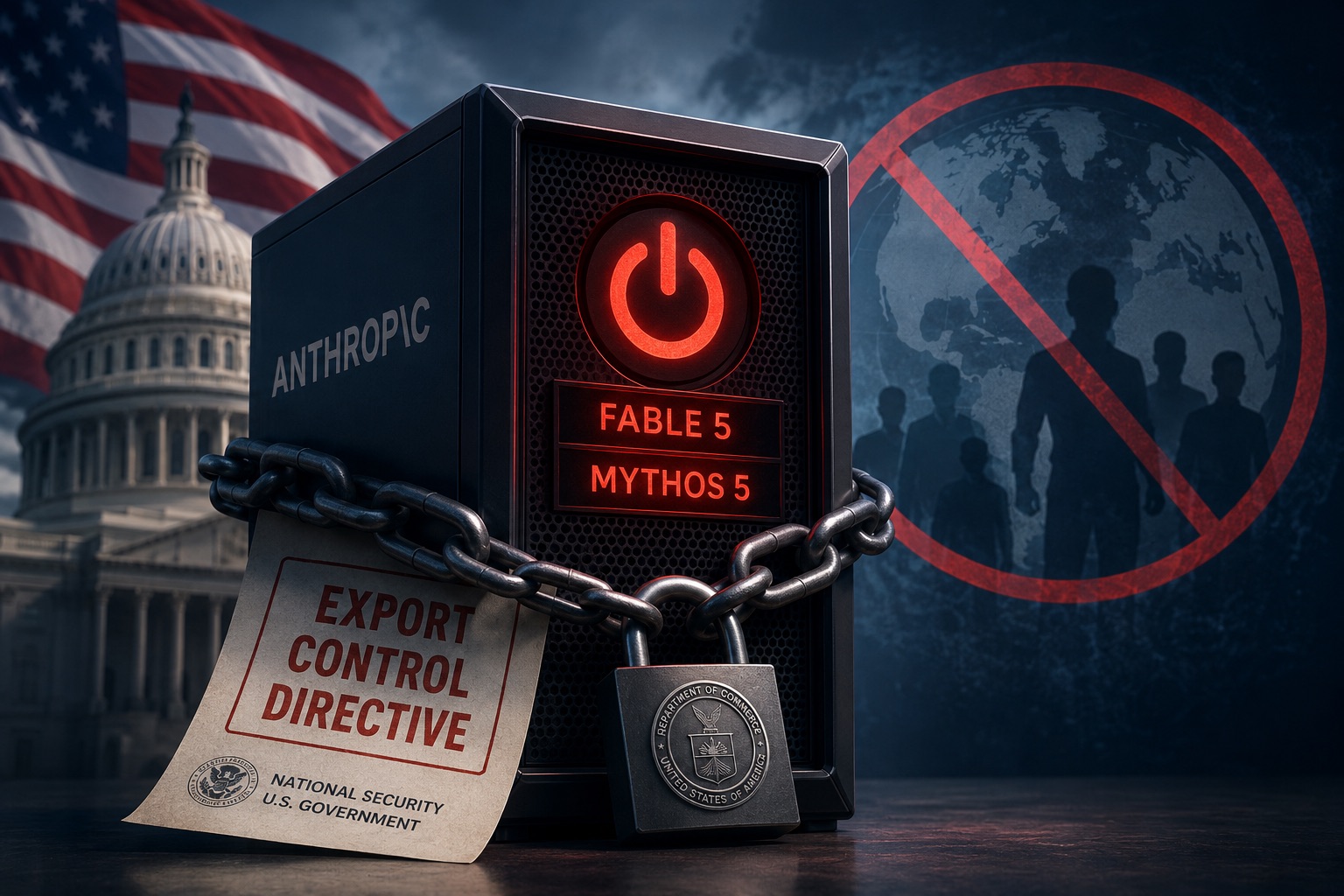
That is, in plain terms, what happened to Anthropic over the weekend of June 12, 2026. The company received a government directive and, within hours, shut down its two most advanced AI models — Fable 5 and Mythos 5 — for every customer worldwide.
Here’s what happened, why it matters, and what it tells us about where AI regulation is heading.
The 60-Second Version
On Friday evening, June 12, the U.S. government sent Anthropic an export control directive citing national security. It ordered the company to block access to Fable 5 and Mythos 5 for any foreign national — whether inside or outside the United States.
The catch: that includes Anthropic’s own foreign-national staff. Because there was no practical way to wall off one group of users from a globally available product, Anthropic did the only thing that guaranteed compliance — it turned the models off for everyone.
The good news for users: every other model, including Claude Opus 4.8, kept working normally. The shutdown was surgical, hitting only the two newest “Mythos-class” systems.
First, What Are Fable 5 and Mythos 5?
If you haven’t been following Anthropic’s releases closely, a quick primer.
Anthropic builds the Claude family of AI models. In 2026 it introduced a new top tier it calls Mythos-class — models that sit a notch above its already-powerful Opus line. These are the systems that made headlines earlier in the year for an uncomfortable reason: they’re exceptionally good at finding and exploiting software vulnerabilities, the kind of skill that’s a gift to cyber-defenders and a nightmare in the wrong hands.
Think of it like this:
- Mythos 5 is a high-performance race car with the speed limiter removed. Anthropic only hands the keys to vetted, trusted partners — cybersecurity defenders working through a program called Project Glasswing.
- Fable 5 is the same engine, but with strict safety locks bolted on so the general public can drive it. When someone asks Fable 5 something risky — around cybersecurity, biology, or chemistry — the request is quietly rerouted to the older, safer Opus 4.8 instead of being answered directly.
Both launched publicly on June 9, just days before the shutdown. To show what the hardware could do, Anthropic pointed to real benchmarks — for example, the payments company Stripe reportedly used a Mythos-class model to migrate a 50-million-line codebase in a single day, work that would normally take an engineering team months.
So these aren’t toys. They’re among the most capable AI systems ever made commercially available — which is exactly why the government was watching.
What the Government Actually Ordered
According to Anthropic’s public statement, the directive arrived at 5:21 p.m. Eastern Time and came under national security authorities, with the Commerce Department confirmed as the sender. Its demand was unusually broad.
Most export controls restrict where a technology can go — you can’t ship it to certain countries. This one restricted who could use it, regardless of location. A foreign national in Dubai and a foreign national working at Anthropic’s San Francisco office were treated the same way: no access.
That scope is what forced Anthropic’s hand. You can’t easily verify the citizenship of hundreds of millions of users in real time, so the only airtight way to comply was a full shutoff. Cloud partners followed suit — access on Amazon Bedrock and the Claude Platform on AWS was revoked to match.
The trigger, as Anthropic understands it, was a reported method of “jailbreaking” Fable 5 — getting around its safety locks.
What’s a jailbreak, and why does it matter here?
A “jailbreak” is a clever prompt or technique that tricks an AI into ignoring its own guardrails. Researchers distinguish between two kinds:
- A universal jailbreak is a master key — it broadly unlocks the model’s restricted abilities. Anthropic says no tester has found one for Fable 5.
- A non-universal jailbreak is a narrow workaround that works in one specific situation. These are far less alarming, and the industry generally accepts that every model has some.
Anthropic argues the government’s concern falls into the narrow, non-universal bucket.
Why Anthropic Is Pushing Back
This is where the story gets interesting. Anthropic is complying with the order — but it openly disagrees with it, which is a striking thing for a company to say about its own regulator.
Its core arguments, paraphrased:
- The evidence was thin and verbal. Anthropic says the letter gave no specific details, and the technical demonstration it reviewed pointed only to a handful of previously known, minor vulnerabilities.
- The “jailbreak” was unremarkable. By Anthropic’s account, the technique essentially amounted to asking the model to read a codebase and fix its flaws — something defenders do every day.
- Other models can already do this. The company says comparable capability is freely available from rival systems, naming OpenAI’s GPT-5.5 specifically.
- The precedent is the real problem. Recalling a model used by hundreds of millions of people over a narrow flaw, Anthropic warns, would — if applied across the industry — effectively halt every new frontier model launch.
Anthropic has long said it supports the government’s right to block genuinely unsafe deployments — but only through a process that is transparent, fair, and grounded in technical facts. Its position is that this action didn’t meet that bar. The company called the situation a likely misunderstanding and said it was working to restore access.
What’s Affected vs. What’s Not
For anyone using Claude in their workflow, here’s the practical breakdown.
| Status | Models | Notes |
|---|---|---|
| Suspended | Fable 5, Mythos 5 | Disabled for all users, on Anthropic’s API and cloud partners like AWS Bedrock |
| Unaffected | Claude Opus 4.8 and all other models | Running normally; no changes to access |
If your apps or tools were routing to Opus, Sonnet, or Haiku, you saw no disruption. If you’d switched a production workflow to Fable 5 in its first few days, you got an abrupt lesson in vendor risk.
The Bigger Picture: Why This Matters
Zoom out, and this is about much more than one company’s bad weekend.
1. AI availability is now a compliance event. For years, the risk with a cloud AI model was downtime or a price hike. Now, a single government letter can make your chosen model vanish overnight — turning model selection into a vendor-risk and business-continuity decision, not just a technical one. Teams that hard-coded a single frontier model are rethinking that.
2. National security and AI are colliding in public. Governments have quietly worried about advanced AI’s cyber and bio capabilities for a while. This is one of the most far-reaching public actions taken in response — and it lands squarely on capabilities (finding software exploits) rather than on a specific harmful act that occurred.
3. The “foreign national” framing is a first. Restricting a consumer technology by user citizenship rather than destination country is a new flavor of export control. It echoes ideas reportedly floated during recent White House discussions on AI policy, including an executive order encouraging companies to share advanced cyber-capable models with the government before wider release.
4. The timing is loaded. Anthropic reportedly filed confidentially for a public listing earlier in June. A high-profile clash with regulators over its flagship product is not the headline a company wants in that window — which may explain the unusually direct pushback.
What It Means for Builders and Everyday Users
If you’re a developer or run a business on AI tools, a few takeaways:
- Don’t single-source your model. Build your stack so you can swap models without rewriting everything. Provider-independent routing just proved its worth.
- Read the fine print on data and availability. Mythos-class models came with a mandatory 30-day data retention policy — a reminder that the most powerful models often carry the strictest conditions.
- Expect more turbulence, not less. As models get more capable, the gap between “amazing demo” and “regulatory flashpoint” is shrinking. Plan for it.
For everyday users, the reassuring part is that the AI you rely on day-to-day — the mainstream Claude models — kept humming. The drama was confined to the bleeding edge.
Key Takeaways
- What happened: The U.S. government ordered Anthropic to block Fable 5 and Mythos 5 for all foreign nationals; to comply, Anthropic disabled both for everyone.
- Why: A national security directive citing a reported method of jailbreaking Fable 5’s safety guardrails.
- Anthropic’s response: It’s complying but disagrees, calling the evidence narrow, the capability widely available elsewhere, and the precedent dangerous for the whole industry.
- What’s safe: Claude Opus 4.8 and all other models are unaffected and working normally.
- The lesson: AI model availability is now a regulatory and compliance issue — and “single-vendor, single-model” is a riskier bet than it looked a week ago.
This story is moving fast, and Anthropic said it would share more details in the days that follow. Whether access is restored quietly or this becomes a landmark fight over how governments police frontier AI, one thing is already clear: the era of treating powerful AI models as ordinary software products is over.
Sources
- Anthropic — Statement on the US government directive to suspend access to Fable 5 and Mythos 5
- Anthropic — Claude Fable 5 and Claude Mythos 5
- Anthropic — Introducing Claude Fable 5 and Claude Mythos 5
- Anthropic — Data retention practices for Mythos-class models
- The Verge — Anthropic cuts off Fable 5 and Mythos 5 access following government order
- Bloomberg — Anthropic Says US Orders Halt to Foreign Access for Fable 5, Mythos 5 AI Models
- CNN Business — Anthropic suspends all access to Mythos model after US government bans foreign nationals use
- Fortune — Anthropic disables Fable and Mythos AI models after U.S. government bars it from giving foreigners access
- NBC News — Anthropic releases Fable 5, the first public Mythos-class model
- TechCrunch — Anthropic's Claude Fable 5 is a version of Mythos the public can access today
- AWS — Claude Fable 5 on AWS: Mythos-class capabilities with built-in safeguards now available
- The Decoder — Anthropic releases Claude Fable 5 and Mythos 5 with major gains in coding and science
- Wikipedia — Claude Mythos