





How Amazon, Google, Apple, and Nvidia are fighting for the soul of artificial intelligence — and what it means for your wallet, your apps, and your privacy
The Empire Strikes… Itself
For years, there was one answer to “what runs AI?” — Nvidia. One vendor, one ecosystem, one eye-watering bill at the end of every quarter.
That era is ending.
In 2026, the AI chip market has fractured into a four-way war between the world’s most valuable companies, each betting billions that they can build silicon better tailored to their needs than anything Nvidia ships off-the-shelf. The result? Cheaper AI, faster apps, and a complete redrawing of the tech industry’s power map.
Here’s what’s actually happening — and why it should matter to you whether you’re a developer, a founder, or just someone who uses ChatGPT or Claude every day.
Meet the Contenders
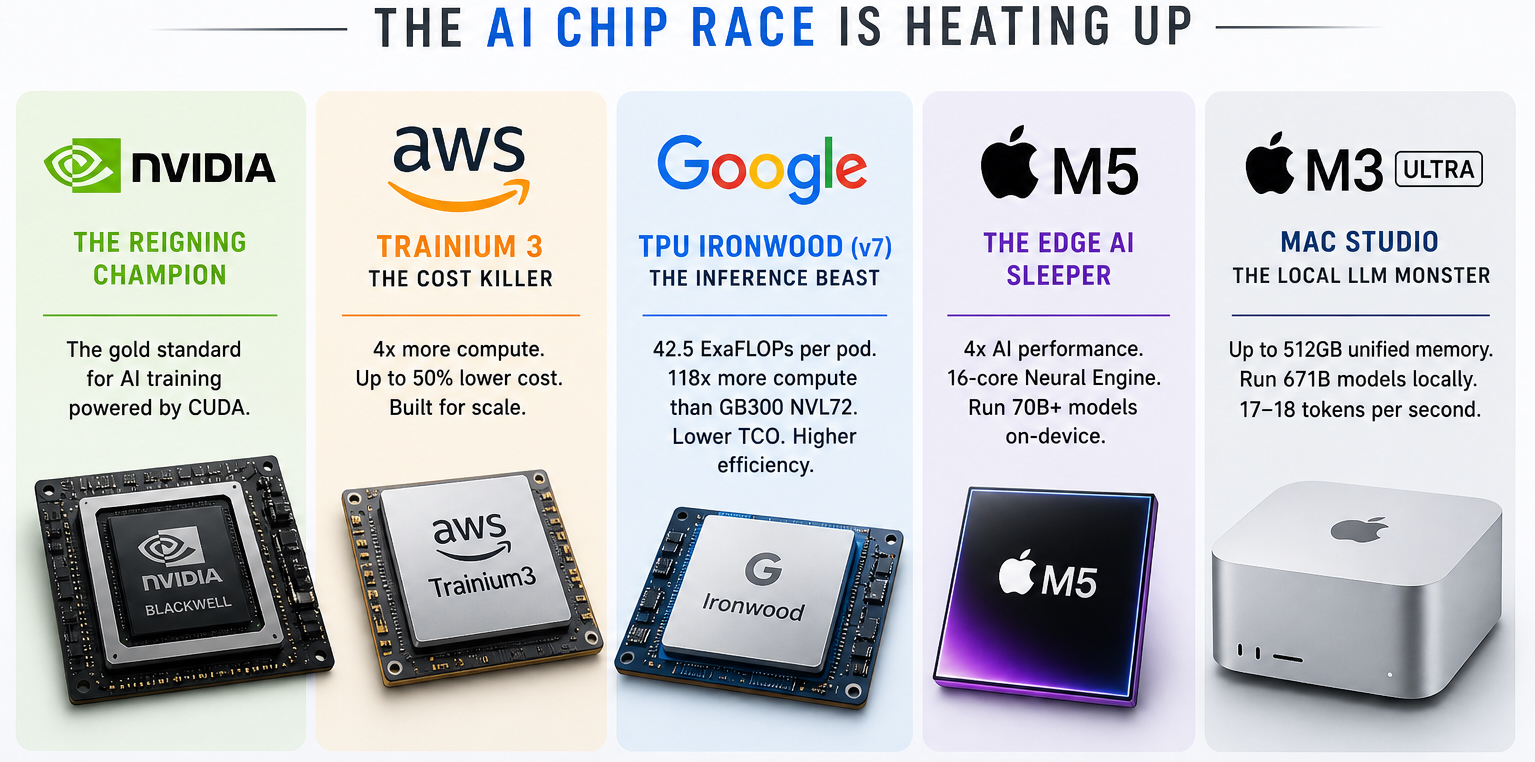
🟢 Nvidia — The Reigning Champion
Nvidia still controls roughly 80–90% of the AI accelerator market by revenue, with training market share above 90%. Its Blackwell B200 and the upcoming Rubin platform remain the gold standard for one big reason: CUDA, the software ecosystem two decades in the making that every AI researcher knows by heart.
But there’s a crack in the armor. About 40% of Nvidia’s revenue comes from just four hyperscalers — Google, Amazon, Microsoft, and Meta — and all four are now building chips specifically to reduce their dependence on it.
🟠 Amazon Trainium 3 — The Cost Killer
Announced at AWS re:Invent 2025, the Trainium 3 chip is built on TSMC’s 3nm process and packs into “Trn3 UltraServers” of up to 144 chips per system, delivering 362 FP8 PFLOPs with 4x lower latency than its predecessor.
The numbers that matter to customers:
- 4x more compute than Trainium 2
- 40% better energy efficiency
- Up to 50% lower cost versus equivalent GPU setups
- Up to 1 million chips linkable in a single UltraCluster
Customer signal: AWS Trainium already processes over 50% of Amazon Bedrock’s token throughput, and Anthropic — yes, the makers of Claude — committed to spending $100+ billion on AWS over a decade, with nearly a million Trainium 2 chips already training Claude today.
🔵 Google TPU Ironwood (v7) — The Inference Beast
Google’s seventh-generation TPU, Ironwood, launched in late 2025 and is genuinely jaw-dropping:
- 4,614 FP8 TFLOPs per chip with 192GB of HBM3e memory (6x Trillium’s capacity)
- Scales to 9,216 chips in a single superpod delivering 42.5 FP8 ExaFLOPs of compute
- That’s roughly 118x more compute than Nvidia’s GB300 NVL72 system at the pod level
- 10x peak performance over TPU v5p, 4x better per-chip efficiency vs Trillium
- All-in TCO per chip is approximately 44% lower than a GB200 server
Anthropic announced plans to access up to 1 million TPUs — a deal worth tens of billions of dollars — citing “strong price-performance and efficiency.” Translation: even the king of CUDA-trained models is voting with its wallet.
🍎 Apple M5 — The Edge AI Sleeper
Here’s the chip nobody talks about in the hyperscaler conversation, but should: Apple’s M5, released in October 2025.
It’s not designed for training trillion-parameter foundation models. It’s designed for something arguably more disruptive — running AI directly on your laptop, tablet, or headset, without sending a single byte to the cloud.
The specs:
- Built on third-generation 3nm technology
- 10-core GPU with a Neural Accelerator in every single core
- Over 4x the peak GPU compute for AI versus M4
- 16-core Neural Engine delivering up to 38 TOPS
- 153 GB/s unified memory bandwidth (nearly 30% over M4)
- Up to 128 GB of unified memory on the M5 Max — enough to run 70B+ parameter models entirely on-device
The M5 Max takes things further with a Fusion Architecture linking two dies into one SoC, scaling to a 40-core GPU. Real-world result: a 14-billion-parameter language model can deliver its first token in under 10 seconds on a MacBook Pro. AI image generation is 3.8x faster than the previous generation.
🖥️ Apple M3 Ultra Mac Studio — The Local LLM Monster
If the M5 is the edge AI sleeper, the Mac Studio with M3 Ultra is the local LLM workstation that quietly broke the rules of what’s possible on a desktop.
Released in March 2025, this is the chip that made the AI developer community do a double-take. Why? Up to 512GB of unified memory at 819 GB/s bandwidth — in a box smaller than a stack of pizza boxes, for under $10,000.
The specs that matter:
- 32-core CPU + 80-core GPU (the largest GPU Apple has ever shipped)
- Up to 512GB of unified memory with 819 GB/s bandwidth
- Six Thunderbolt 5 ports for clustering multiple Mac Studios into 1TB+ memory pools
- Built on UltraFusion, linking two M3 Max dies into one SoC with coherent caches
- Pricing: $9,499 for the 512GB / 1TB SSD config, up to ~$14,099 fully loaded
Here’s what makes it remarkable: the M3 Ultra is the only consumer device on the planet that can run DeepSeek R1 (671 billion parameters) entirely locally. Real-world benchmarks show it pulling 17–18 tokens per second on the full 4-bit quantized model — sufficient for most practical applications, and doing it without a single API call leaving the machine.
Compare that to the alternative. To match the 512GB unified memory of one Mac Studio with Nvidia hardware, you’d need roughly 16 RTX 5090 GPUs — costing 4x more upfront and consuming roughly 40x the electricity. For a business running LLMs 10 hours per day, that’s the difference between ~$10/month and ~$400/month in electricity alone. The Mac pays for itself just on power savings.
The catch? Raw GPU compute per dollar still favors Nvidia for batch-processing workloads, and many AI frameworks remain Nvidia-first. But for memory-bound workloads — running massive models with long context windows, sensitive enterprise data that can’t go to the cloud, or rapid local prototyping — there’s genuinely nothing else like it.
Why the M3 Ultra and not an “M4 Ultra”? Apple didn’t include the UltraFusion connectors on the M4 Max die, making a fourth-generation Ultra physically impossible. So the M3 Ultra remains Apple’s flagship desktop AI chip — and likely will until the M5 Ultra arrives.
Head-to-Head: Performance, Price, and Where Each One Wins
| Chip | Best At | Peak Compute | Memory | Approx. Cost Position | Where to Get It |
|---|---|---|---|---|---|
| Nvidia B200/GB300 | Frontier model training | 4.5 PFLOPs FP8 | 192GB HBM3e | Premium (highest margins in the industry) | Everywhere — AWS, Azure, GCP, on-prem |
| AWS Trainium 3 | Cost-optimized cloud training & Bedrock inference | ~362 FP8 PFLOPs / UltraServer | 144 chips per server | ~50% cheaper than GPU equivalents | AWS only |
| Google TPU Ironwood | Massive-scale inference & frontier training | 4,614 FP8 TFLOPs/chip | 192GB HBM3e | ~44% lower TCO than GB200 | Google Cloud only |
| Apple M5 / M5 Max | On-device inference, creative AI, privacy-first apps | ~38 TOPS Neural Engine + 4x GPU AI compute | Up to 128GB unified | $1,999–$3,999 (laptop included!) | Any Apple Store |
| Apple M3 Ultra (Mac Studio) | Running massive LLMs locally, privacy-critical workloads | 80-core GPU, 819 GB/s bandwidth | Up to 512GB unified memory | $9,499–$14,099 | Apple direct |
The Key Insight: There Is No “Best” Chip
Each of these chips wins a completely different battle:
- Training a frontier model from scratch? Nvidia still has the deepest software stack and most flexible programming model.
- Serving billions of API calls cheaply? Trainium and Ironwood are eating Nvidia’s lunch on inference economics.
- Running AI on a laptop without internet? Apple Silicon (M5) is in a category of its own.
- Running a 671-billion parameter model on your desk? The Mac Studio M3 Ultra is — astonishingly — the only consumer machine that can do it.
The era of single-vendor dependency is over. Welcome to the multi-chip, multi-vendor AI era.
What This Means for Companies
💰 Lower Costs, Better Margins
If you’re running AI workloads at scale, the math is suddenly very different. Companies including Anthropic, Karakuri, Metagenomi, NetoAI, Ricoh, and Splash Music are reducing training costs by up to 50% with Trainium. Decart is achieving 4x faster generative video inference at half the cost of GPUs.
For a startup burning $50,000/month on inference, that’s potentially $25,000 back in the bank every month — money that goes into product, hiring, or runway.
🚀 Faster Time to Market
Training cycles that used to take months are now taking weeks. Pfizer is using Claude on Bedrock (running on AWS silicon) to save tens of millions in operational costs while accelerating drug research timelines. Lyft built a Claude-powered support agent for over 1 million drivers, achieving an 87% reduction in average resolution time.
🔓 Vendor Diversification
Until now, an AI strategy was effectively “buy whatever Nvidia GPUs you can find.” Now smart companies are running hybrid stacks: training on Nvidia where flexibility matters, inferring on Trainium or TPUs where cost matters, and pushing latency-sensitive features down to Apple Silicon devices.
⚖️ The Catch: New Lock-Ins
Trainium runs only on AWS. TPUs run only on Google Cloud. Choosing custom silicon means choosing a cloud — at least for now. The savings are real, but so is the strategic dependency.
What This Means for Users
⚡ Faster, Cheaper, Better AI Apps
When inference costs drop 50%, that compounds through the entire stack. Expect:
- AI features in apps you already use to get dramatically faster
- Free tiers to get more generous
- Premium subscriptions to get more capable at the same price
- Whole new categories of AI apps that simply weren’t economic to build before
🔐 Privacy Without Compromise
This is where Apple Silicon changes the conversation entirely. Until 2025, “AI feature” basically meant “your data goes to a server somewhere.” With the M5 generation, you can now run a 14-billion-parameter language model entirely on your laptop — no cloud, no telemetry, no tradeoffs.
And if you go up to the Mac Studio with M3 Ultra, you can run frontier-class models locally — DeepSeek R1 with 671 billion parameters, full context, no compromises. For a hospital, a law firm, an investment bank, or a government agency where data sovereignty isn’t optional, this is genuinely revolutionary. The AI never leaves the building.
For anyone in healthcare, law, finance, or just someone who values privacy, this is genuinely transformative. Your therapist’s notes, your legal documents, your code — they never have to leave your device.
🌍 More Sustainable AI
The 40% energy efficiency gains in Trainium 3, combined with similar leaps in TPU and Apple Silicon efficiency, mean the AI revolution doesn’t have to come with an unaffordable carbon footprint. In an industry racing to build gigawatt-scale data centers, drinking less, not more has become a competitive feature.
The Outlook: Who Wins by 2028?
The forecasts are striking. Custom ASIC shipments are projected to triple by 2027 versus 2024 levels and surpass GPU shipments by 2028. Hyperscalers are expected to deploy 40 million custom AI chips cumulatively between 2024 and 2028.
Nvidia’s overall market share is projected to slide from ~85% today to roughly 75% by 2026, with its inference share potentially falling from 90%+ to 20–30% by 2028.
But here’s the nuance: Nvidia isn’t losing — the pie is getting much bigger. The AI accelerator market has grown from $55B in 2023 to ~$160B in 2025, heading toward $200B+ in 2026. Even at 75% share, Nvidia’s revenue keeps growing in absolute terms.
What’s actually ending is monopoly-grade pricing power. And that, more than anything else, is why custom silicon matters.
The Bottom Line
We are watching, in real time, the most dramatic shift in computing economics since the rise of cloud itself.
Three things are now simultaneously true:
- Nvidia is still dominant — and will remain so for years.
- Custom silicon from Amazon, Google, Microsoft, and Meta is structurally eroding that dominance, especially in inference.
- Apple is quietly building the most disruptive chip story of all by making the cloud optional.
The winners aren’t going to be “Nvidia vs. the rest.” The winners will be the companies — and users — who learn to navigate this new multi-chip world fluently, choosing the right silicon for the right workload at the right price.
The AI gold rush of 2023–2024 was about getting any compute at any price. The AI gold rush of 2026 is about getting smart compute at the right price.
Same revolution. New rules.
Have thoughts on which chip is winning your stack? Or which one you’re betting on for the next 12 months? Drop a comment — we’d love to hear how you’re navigating the shift.